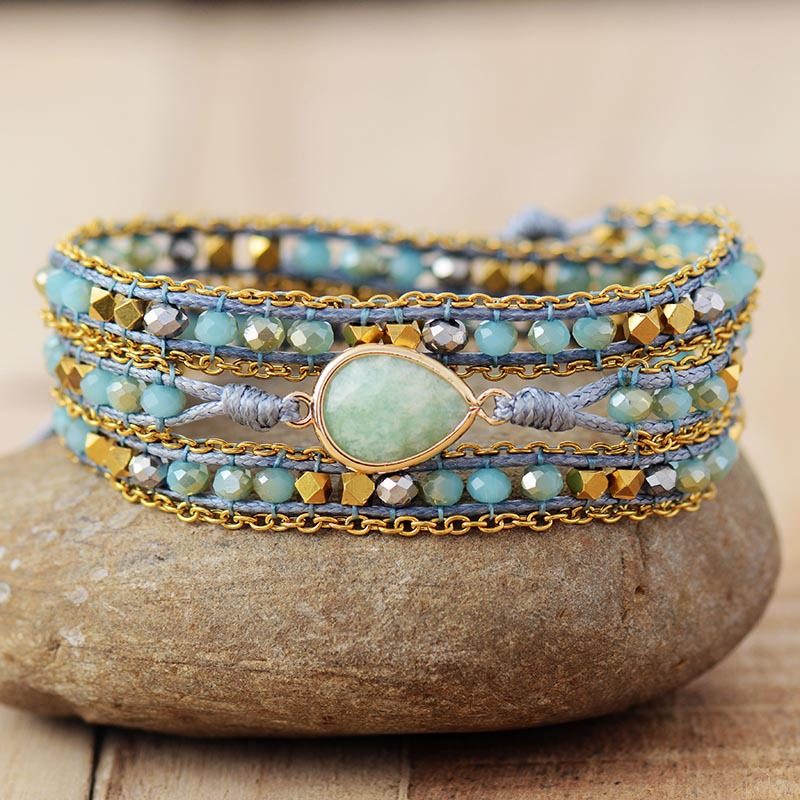
Amazonite does a very particular thing. It looks like moving water, which is why this bracelet gets worn all summer and why, once a year, we take it apart and put it back together. Here is how it is made, how it wears, and the maintenance nobody mentions.
Before you read on
As an Amazon Associate I earn from qualifying purchases. Retailer links in this article are affiliate links and cost you nothing extra. We only link to tools we use or would genuinely buy. Full wording on our affiliate disclosure page.
Why amazonite, of all the stones
We did not set out to build a summer bracelet. We set out to find a stone that looked like cold water, because a customer had asked for something “the colour of a stream on a hot day” and would not accept turquoise. Turquoise is opaque and chalky. What she wanted was the other thing, the milky green-blue you get where a river runs shallow over pale stones.
Amazonite is that colour, and then it gets better. Look closely at the beads in the photograph and you will see faint white veining running through the pale aqua, a sort of cloud inside the stone. No two beads are the same shade. Some run green, some run almost pale blue, one or two have a grey cast that sounds like a flaw in writing and looks magnificent in a pile. If you want a set where every bead is identical, this is not your stone. If you want the thing that makes people lean in and ask what it is, it is.
The other reason we keep coming back to it: amazonite is a feldspar, so it has a soft surface glow rather than the hard glassy shine of quartz. Photographed on driftwood, the way we shoot it, it looks like it belongs outdoors. That is entirely the point.
How the bracelet is built
This is a wrap bracelet, which means it goes around the wrist more than once and closes at the end. Ours is designed to wrap three times.
The three cord wraps
The base is a sage-green cord, not leather. We started with leather and it was wrong for this design — leather is too stiff to wrap three times neatly, and it darkens the aqua of the stones. The green cord is soft enough to lie flat against the skin and quiet enough to let the amazonite do the talking. It is a colour that reads as plant, not as mint.
The gold curb chains
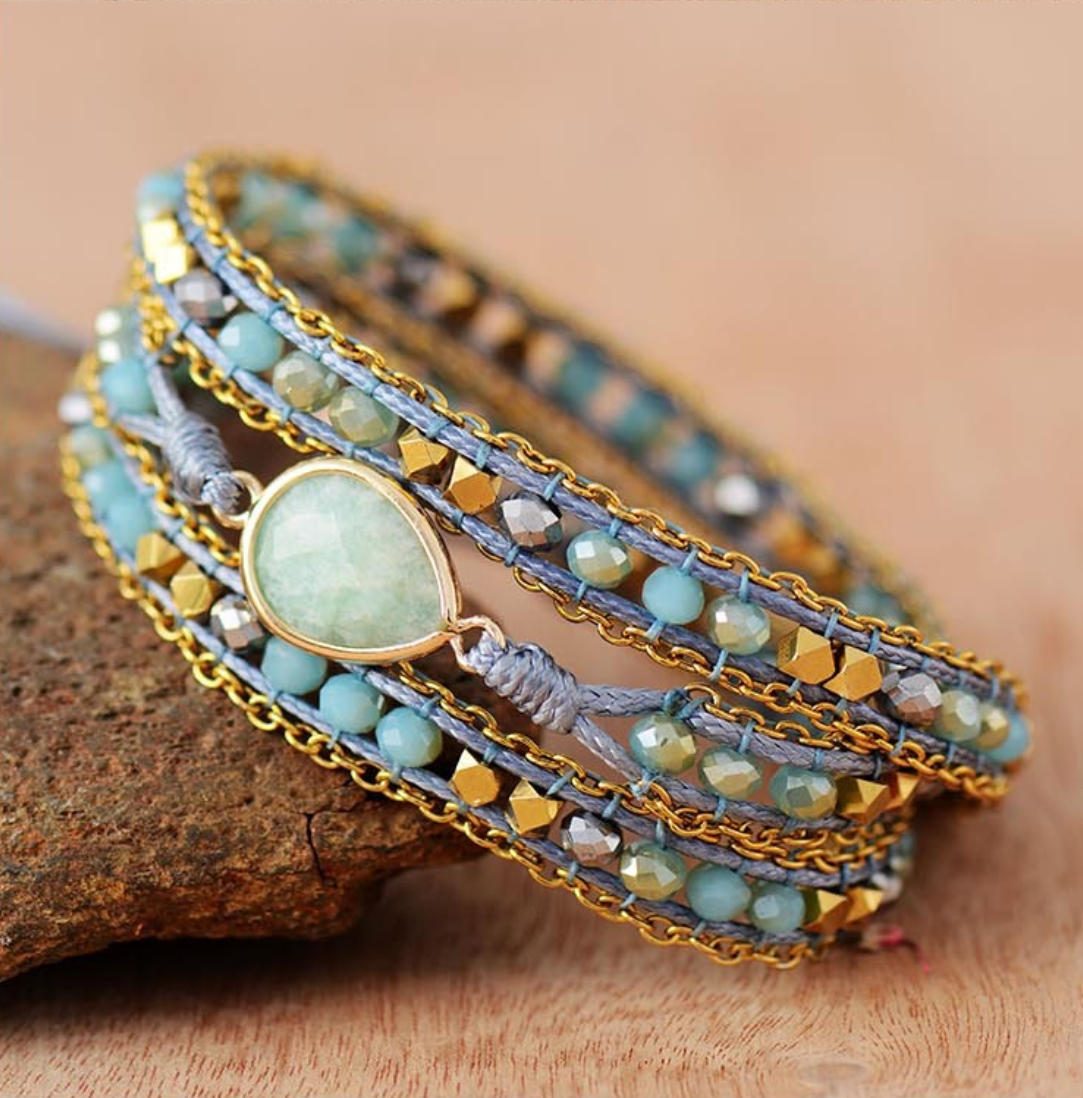
Running alongside the beads are lengths of fine gold-tone curb chain. They are there to break up the rhythm. Without them the bracelet is just a string of stones; with them, light moves along the wrist as you turn your hand. We keep the chain fine rather than chunky, because a heavy chain would pull the cord out of shape when the bracelet is worn three times over. Proportion again: the stones should stay the heaviest thing here.
Crystals between the beads
Between the larger amazonite beads sit small faceted crystals, and they are deliberate. A faceted stone throws a spark of light back at the camera and at the eye, while a smooth one just absorbs it. Alternating smooth amazonite with facets means the bracelet never goes flat. This is the kind of detail nobody notices consciously and everybody notices unconsciously.
The knotted teardrop focal
The centrepiece is a single teardrop-shaped stone, knotted in place rather than glued into a setting. A good knot holds it from behind, leaves the whole face of the stone visible, and will not fail the way a glued setting can. It also means that if the drop is ever damaged, it can be replaced without rebuilding the whole bracelet.
The heart button and the adjustable knot
This is the part customers ask about most, because it is the part you touch every day.
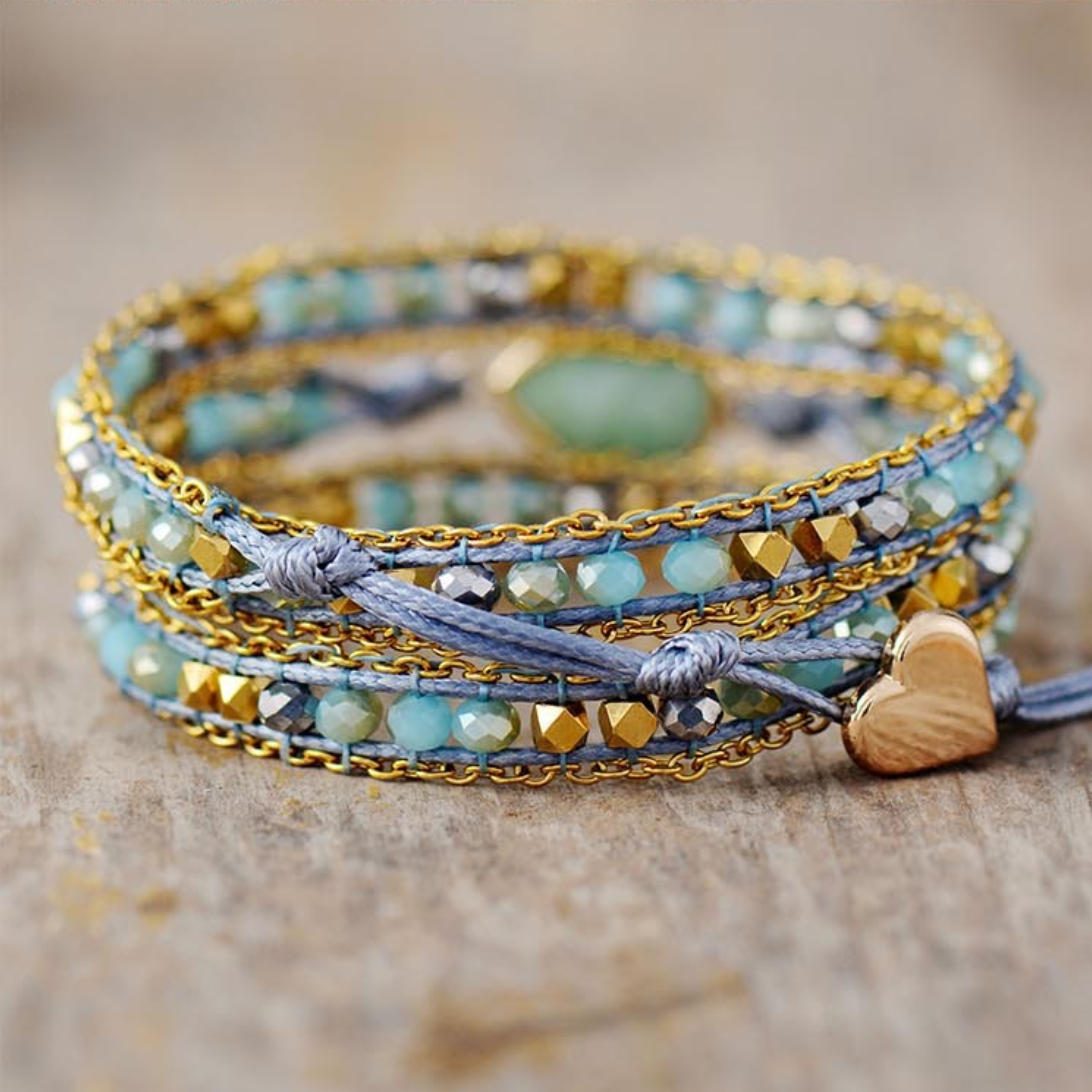
The bracelet closes with a small gold heart button. The cord on the other end loops over it. It is a button closure rather than a clasp for a reason: buttons do not have a hinge to weaken, they do not catch hair, and they are easy to fasten one-handed, which matters when you are putting a bracelet on your own wrist in a hurry.
The other end carries an adjustable sliding knot. That is what lets the same bracelet sit on a wrist as narrow as fourteen centimetres and as wide as nineteen. It is also the honest weak point of the whole piece, and we will cover that below. For now, know that the knot is meant to be slid, not yanked, and that it should never be left under tension for months at a time.
How it sits on the wrist, and how to stack it
Three wraps of a fairly fine bracelet sits close to the wrist, more like a woven band than a bangle. That low profile is what makes it easy to live with. It does not clatter on a desk, it does not slide up and down the forearm, and it fits under a sleeve without printing through the fabric.
Stacking is where it earns its place. Worn next to a watch, this is the bracelet that stays out of the way — the beads are small enough not to scratch a watch face, and the green cord ties the two together if your watch band is even faintly in the same family. Keep everything on one wrist, and keep the whole stack close to the hand. Two wrists full of jewellery is not a stack, it is a costume.
Colour advice, since we get asked: amazonite is one of the easiest stones to wear because the pale aqua behaves like a neutral against denim, white linen and grey, but comes alive against olive, sand and terracotta. It looks very good with silver, and surprisingly good with a single warm gold piece, as long as gold is the accent and not the theme.
The maintenance note nobody gives you
Here is the honest part. We restring our own display bracelet every spring, and we tell customers to expect to do the same, or to send it back to us and let us do it.
Why? Because any bead-wrap bracelet made of cord has a life span. Cord abrades. The sliding knot tightens and loosens a few hundred times over a summer, and it is the first thing to fatigue. Sunscreen and salt water, both of which this bracelet will absolutely meet, are unkind to natural cord. None of that is a design flaw — it is simply what happens when you make something this tactile out of materials that respond to the body. A bracelet you can adjust is a bracelet you will wear every day, and a bracelet you wear every day will need redoing.
The good news is that a restring is cheap and quick, and here is the routine we suggest:
- Take it off before swimming, showering, or applying lotion or sunscreen. Not for the stones — for the cord and the knot.
- Slide the adjustable knot, do not pull it. A yanked knot stresses the cord exactly where it will break later.
- Store it flat or loosely coiled, not hung from the button. Hanging puts the whole weight on one knot all winter.
- Once a year, cut the cord, keep the beads and chains, and restring. Ten minutes on the bench and it is new again.
Studio pick
Beading cord for wrap bracelets. Look for a strong, slightly stiff cord in a natural tone rather than a shiny craft cord. The right cord holds a knot without slowly creeping loose, which is the single most common reason a homemade wrap bracelet falls apart. A spool will restring this bracelet many times over.
Studio pick
A small crimp and knot kit. If you plan to make or repair wrap bracelets, a basic kit with crimp beads, a crimping tool and a couple of jewellery pliers pays for itself the first time you avoid paying someone else to restring a piece. It also makes the difference between a knot that holds for a summer and one that holds for years.
If you make one, make a spare
The first wrap bracelet we made was too tight across the top and too loose at the button, which is a classic beginner mistake: it is very easy to fix the total length and forget that the sliding knot needs a little slack of its own to do its job. Leave an extra few centimetres of tail beyond the knot. Once you have worn one for a summer, you will understand why we keep two on the bench — one to wear, one resting.
The same instinct for honest materials runs through our other pieces. The deep red garnet and cloisonné bracelet is the heavier, evening cousin of this one, built the same way but with a pull chain instead of a button, and the gold leaf botanical painting came out of the same summer palette we were chasing when we first saw this stone. Wear them together if you like your wrists warm and cool at once; it works better than it sounds.