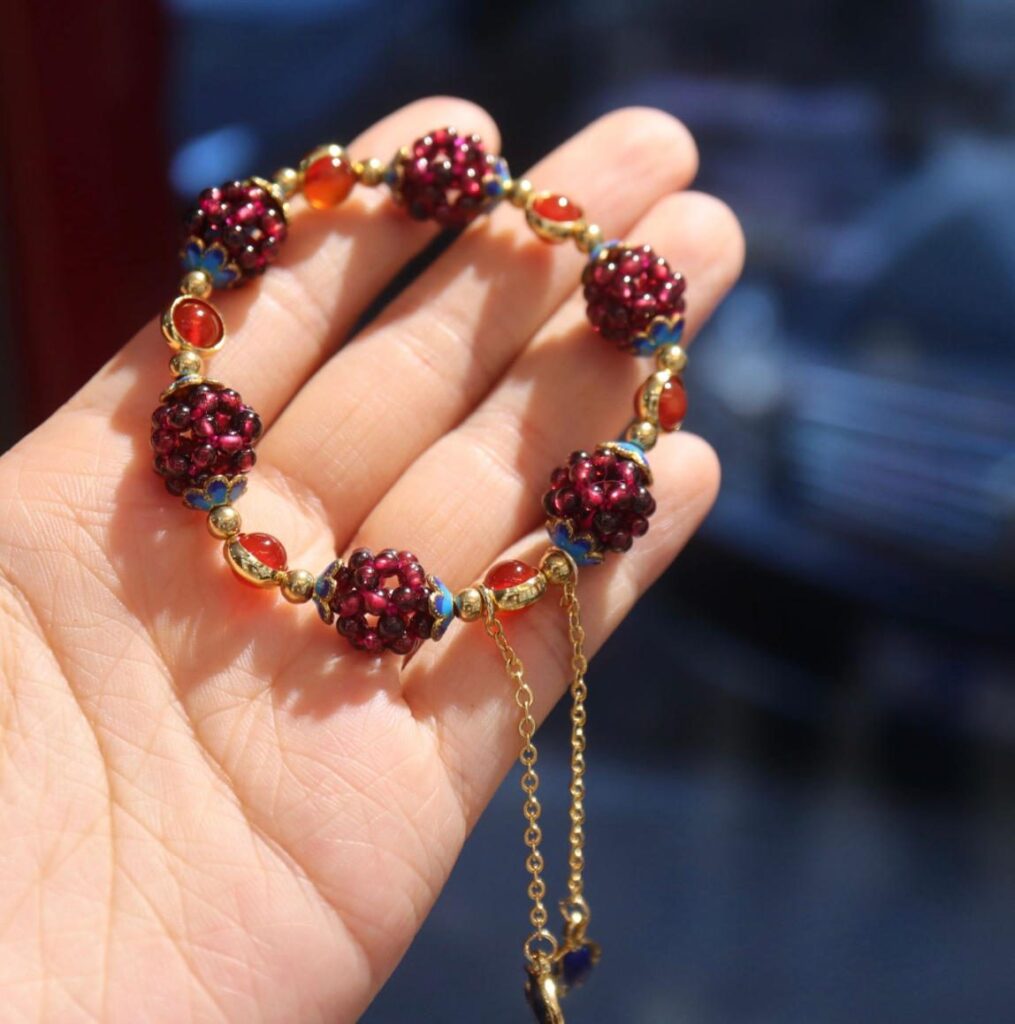
Some pieces are photographs. This one needed a video, because the whole point of the design is how it moves — deep red garnet clusters, blue enamel, and a pull chain that swings. It is also the slowest bracelet we build, and here is why we think it is worth the hours.
Before you read on
As an Amazon Associate I earn from qualifying purchases. Retailer links in this article are affiliate links and cost you nothing extra. We only link to tools we use or would genuinely buy. Full wording on our affiliate disclosure page.
A bracelet that photographs badly
We have tried to shoot this piece properly maybe a dozen times. The still photographs are good — you can see the garnets holding their colour even in the flat light of a grey afternoon — but they lie a little. A photograph makes this look like a row of beads. In the hand, it is nothing like that. It is a row of tiny clusters, each one built from dozens of stones, and when you tilt your wrist the whole thing rolls and catches light in a way that no single frame can hold.
That is why we filmed it. A slow turn of the finished bracelet tells you more about this design than any caption we could write, so somewhere below you will find a short clip of the piece rotating on the bench. Watch the garnet clusters move. That rolling depth is the entire reason we make it this way, stone by stone, instead of threading plain garnet beads onto a cord.
What a garnet bead ball actually is
The centrepiece of the bracelet — the round, almost berry-like clusters you can see in the photograph — are not single beads. Each one is built by hand, and each one takes a long time.
Start with a small round core, about the size of a peppercorn. Around that core we weave dozens of tiny garnets, each roughly two millimetres across, using fine wire, covering the core a stone at a time until the whole thing reads as one deep red ball, as round as a real bead. A single ball can use somewhere between thirty and sixty of those two-millimetre stones. Then we make eight or nine of them for one bracelet.
It is, frankly, tedious. There is no rhythm to it the way there is with stringing, and the wire wants to push earlier stones out of place while you seat the next one. We have abandoned a ball halfway through more than once, on the grounds that a tired eye makes a lumpy cluster and a lumpy cluster is obvious from across a room. But the result justifies the hours. A woven ball has a texture and a movement that a solid bead simply cannot imitate, because it is made of hundreds of tiny facets rather than one smooth surface. That is what the camera cannot quite catch and the video can.
Between the garnet clusters sit flat red agate beads, which are smoother and slightly lighter in tone. They give the eye a place to rest. Without them, the clusters compete with each other and the bracelet becomes noise.
The cloisonné spacers, and why the blue works
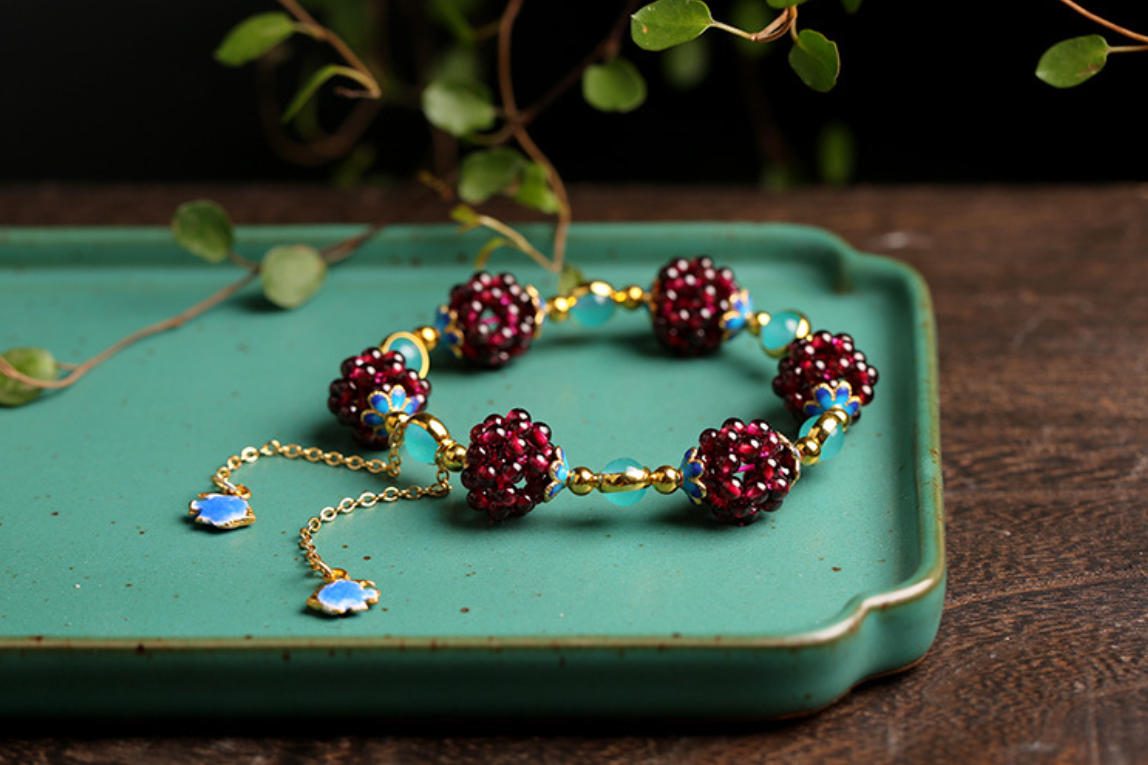
Between the stones are cloisonné enamel spacers in a clear sky blue, each one set with a thin gold-tone rim. Cloisonné is an old process — fine metal walls bent into a pattern, filled with enamel, then fired — and even in a small spacer you can see the discipline in it, because the colour sits inside little chambers rather than just being painted on.
The blue is the decision that makes this bracelet. Garnet on its own, with gold, is a very safe combination: deep red and warm metal, rich but a little heavy, the sort of thing that reads as evening only. Adding the pale blue spacers changes the temperature of the whole piece. Suddenly the red looks brighter, the gold looks warmer, and the bracelet stops being a formal object and starts being something you could wear with a plain shirt. It is a small amount of blue, but it does an enormous amount of work. If you only take one idea from this post, take that one: the way to make a rich colour wearable is not to soften it, it is to put a cool note next to it and let both of them sing.
So the colour story, in full, is garnet and gold with a breath of sky blue. Held in a palm, as in the photograph at the top, it looks almost like a little bowl of fruit.
The pull chain and the little fish
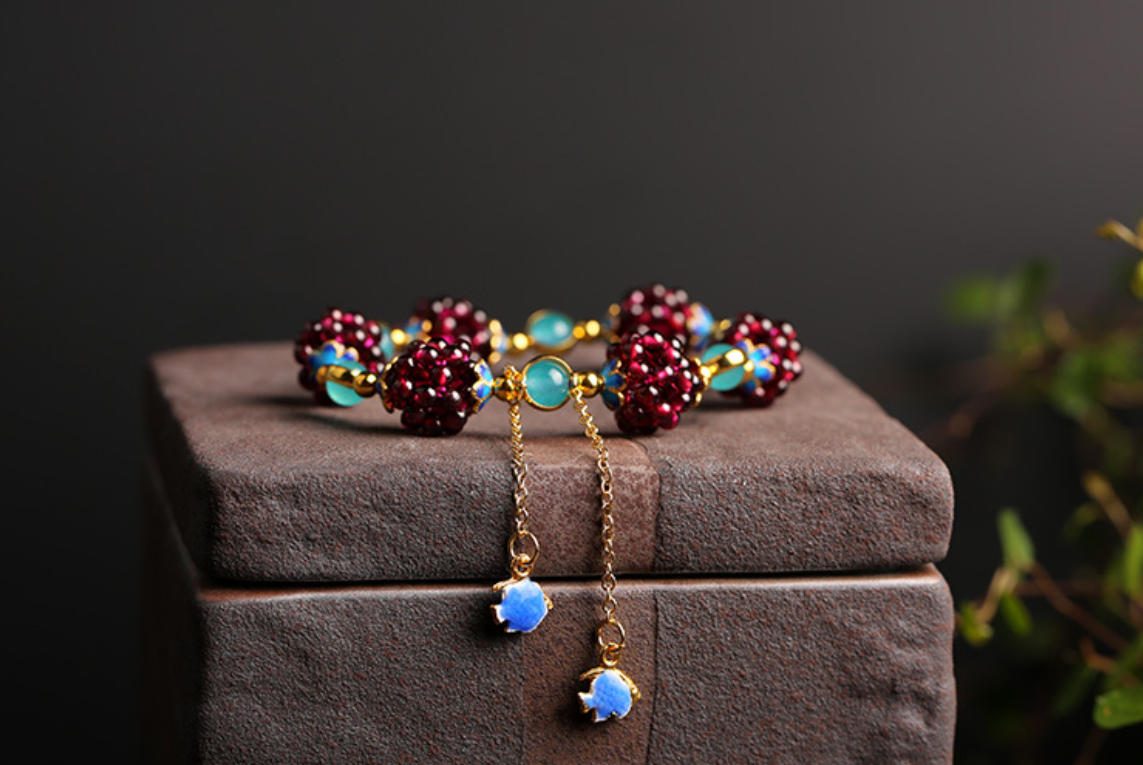
This bracelet closes with an adjustable pull chain rather than a fixed clasp, and the chain is fitted with two small enamel koi-fish charms — the little blue-and-gold fish you can see in the photograph further down. They are the one playful note in an otherwise quite serious piece, and we will not pretend they are practical. They exist because a bracelet with a tiny secret on the end of the chain is a nicer thing to own than a bracelet with a plain ball on the end.
The pull chain itself is the adjustable part: you slide the chain through the anchor bead to set the fit, and the excess hangs as a short tail. That means the same bracelet fits a wrist from about fifteen centimetres up to nineteen or so. It also means the tail should hang rather than be tucked, because the weight of the fish is what keeps the chain sitting neatly along the wrist instead of flipping over.
Two honest notes on the chain. First, slide it gently. A pull chain is a friction fitting and it will eventually loosen if it is yanked every single day. Second, if you have a habit of catching chains on door handles — and we do — fasten it slightly snugger than you think you need, so there is less tail to catch.
Wearing it, and gifting it
On the wrist, this is a bracelet that wants a little room. It likes a bare forearm, a pushed-up sleeve, or the cuff of a knit that stops short of the wrist. It is heavier than our wrap bracelet, so it reads as the piece you notice rather than the piece you stack — although it can be stacked with something fine, as long as the fine thing is silver or pale gold and stays out of the way.
Because the garnet is a saturated red, it looks its best against black, cream, olive and charcoal, and it looks unexpectedly lovely against denim. It is not afraid of a formal dress, but that blue note keeps it from being stuck there.
It also happens to be the easiest gift in our range to get right, because garnet is the birthstone for January, and a deep red stone is one of the few things that suits almost everyone. If you are buying for someone born in that month, you have a reason built into the design. If you are buying for anyone else, you have a bracelet that finds its own reason once it is on the wrist. Either way, the koi on the end gives it a story to tell, which is always worth more than a box.
Studio pick
Small garnet beads for weaving clusters. If you want to try a woven ball yourself, look for a size-consistent batch of round garnet around two millimetres. Consistency matters more than size here — mixed sizes make a lumpy cluster, and a cluster full of gaps looks unfinished even when the weave is tight. Buy more than you think you need, because you will lose several.
Studio pick
Cloisonné enamel spacers. The blue spacers are what make this design sing, so it is worth choosing ones with a clean rim and an even enamel fill. Check the hole size before you fall in love with a colour — a spacer that will not take your cord or wire is a spacer you cannot use, no matter how good it looks in the photo.
Make one, or wear ours
If you have ever woven beads, the balls are a good winter project — slow, repetitive, oddly calming once you stop waiting for progress. Start with one ball and see how it goes before you commit to a whole bracelet’s worth. Most people, though, would rather just own the finished thing, and we do not blame them. This is one of the pieces where the hours are real and you can see every single one of them in the finished bracelet.
The blue-and-red idea travels, too. If you like this bracelet, the lighter, summery version of the same thinking is our aqua amazonite wrap bracelet, which uses a cool stone and warm gold the other way around. And in the hair, the carved carnelian pumpkin hairpin shares the garnet family’s warm red, so the two can be worn as an unspoken set. Between them, they cover most of what we actually believe about colour: deep tones, one cool note, and let the stones do the rest.