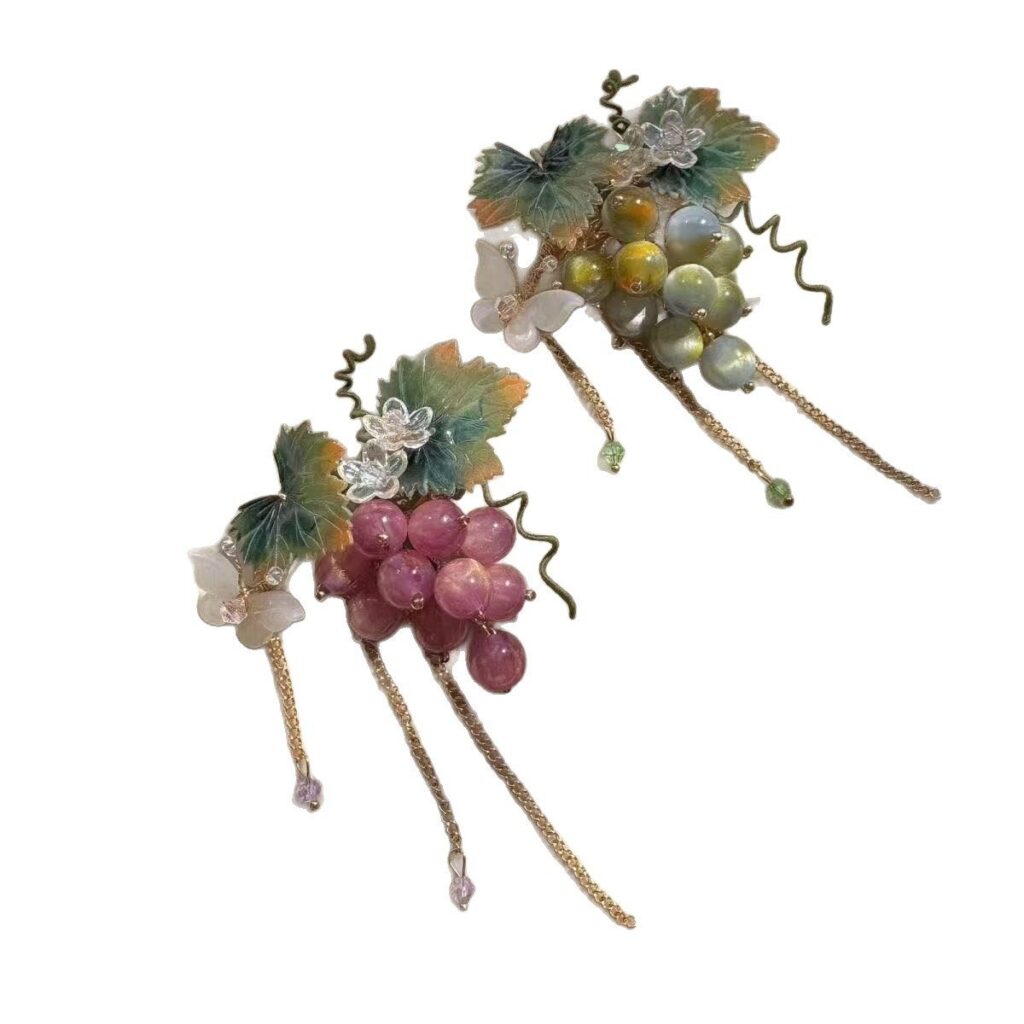
We made these for a market stall as a last-minute filler, sold out in a morning, and have not stopped making them since. Two little bunches of glass grapes on a gold clip, with chains that swing when you move. Here is how they are built, and the one thing you must not do with them.
Before you read on
As an Amazon Associate I earn from qualifying purchases. Retailer links in this article are affiliate links and cost you nothing extra. We only link to tools we use or would genuinely buy. Full wording on our affiliate disclosure page.
The clip that was never supposed to be popular
These started as filler, and that is the honest story. We had a Saturday market booked, a table that looked half empty, and a spare afternoon. Grapes had been on our mind all year — we bead a lot of fruit, it photographs well, and a bunch of grapes is one of the few shapes that looks satisfying to make and even more satisfying to follow with the eye. So we wired up a handful on cheap clips, put them at the corner of the table to fill the gap, and expected them to sit there.
They were gone before lunch. Not the whole stock of everything, just the grapes. Three people bought them as gifts for people with grape-related surnames, which we had not thought of and now cannot unsee. By the second market we had doubled the batch and they still sold out first.
We have stopped being surprised. What we have not stopped is making them by hand, one bunch at a time, because the moment you speed this design up it stops being good — the whole charm of a bunch of grapes is that no two berries sit exactly the same way.
How each bunch is actually made
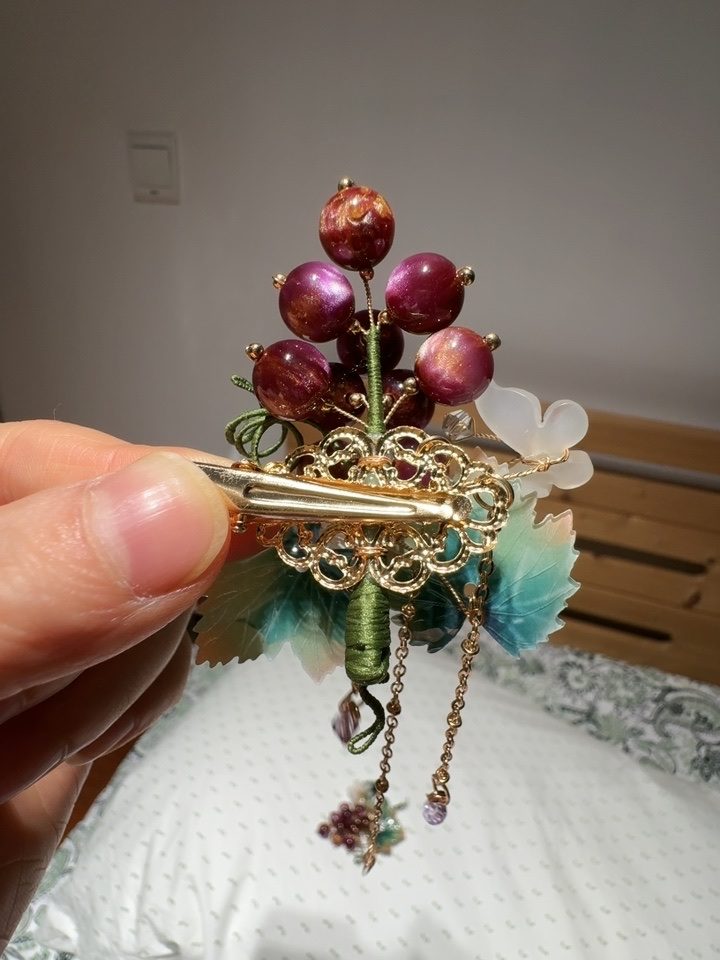
Start with the clip base, which is a gold filigree alligator clip, the kind with a flat decorative top and a spring jaw underneath. The flat top matters: it gives you something to wire against, and a plain flat clip can be hidden almost entirely by the bunch that sits on it.
Then the slow part. Each grape is wired onto the base bead by bead, not glued, not strung on a single wire and bent into shape. Working from the highest berry in the bunch downward, we thread a fine gold wire through the filigree, catch the first glass grape, bring the wire back through, and twist it tight on the reverse. Then the next grape, slightly to one side and slightly lower, overlapping the first. Then the next. A single bunch is somewhere between fifteen and twenty berries, and the shape is not fixed in advance — you build it, look at it, and add or remove a berry until it hangs like a real bunch, wider at the top and tapering to a point.
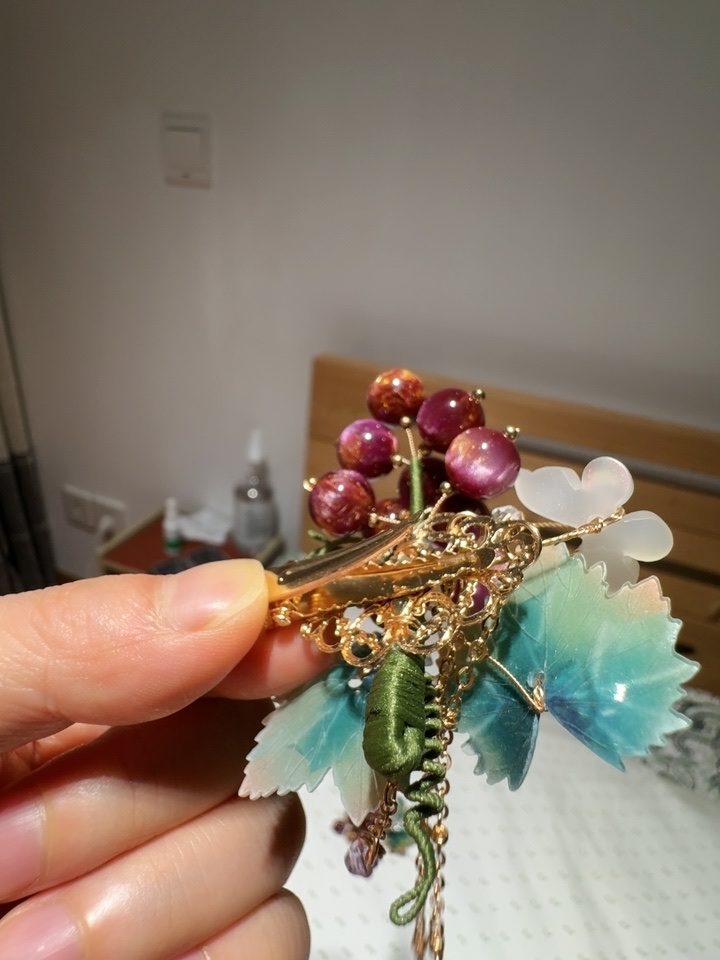
Wiring rather than gluing is not a stylistic choice, it is a practical one. Glue yellows, glue fails under the warmth of a head, and glue leaves a hard blob that you can feel through the clip. Wire holds, and it lets us build the bunch in three dimensions instead of pressing berries flat onto a surface. That three-dimensional build is the difference between grapes that look like fruit and grapes that look like a sticker.
Around the top of the bunch we add a few enamel-green leaves, wired low so they sit under the cluster rather than sticking out like a flag. They do the same job the leaves do on our other pieces: they make the fruit feel like it came off a plant instead of out of a box.
The chains and the crystal drops
Hanging from the bottom of each bunch are two or three fine gold chains, and at the end of each chain is a tiny faceted crystal drop. This is the detail that turns a decorative clip into something people stop you to ask about. When you move your head, the chains swing a fraction of a second behind, and the crystals catch light as they go. It is a small movement and it is completely out of proportion to how much people enjoy it.
We keep the chains fine and the drops small on purpose. A heavier chain would pull the clip down the hair and a bigger drop would tangle. The whole point is a suggestion of movement, not a wind chime.
Two colourways: plum and sage
We make the grapes in two colours, and they behave very differently.
Plum is the deeper, more autumnal version — glass berries in a rich purple-red with a little translucency, so they darken where they overlap and glow where a single berry catches the light. This is the one that reads as jewellery. It suits dark hair beautifully, because the warm plum stands out against it, and it suits evening and colder months.
Sage-green is the literal one, closer to actual grapes, softer and slightly milkier. On light or grey hair it nearly disappears and then catches the light as you move, which is a very quiet, very lovely effect. It is the one we wear in summer, and the one people describe as “oh, that’s clever” rather than “oh, that’s beautiful”. Both are compliments. Only you know which one you want.
If you genuinely cannot choose, this is a case where buying both is defensible. They are small, they take up almost no room, and a plum bunch for a dark outfit with a sage one for a light one is a complete little wardrobe.
Where to place a clip like this
The clip is an alligator clip, so it grips anything with a bit of thickness — a twist, a half-up section, the edge of a bun.
- Half-up styles. This is the easiest and possibly the best. Pull back the front section, twist it once, and clip the bunch just above and to one side of the twist. The chains hang into the loose hair and the whole thing looks effortless.
- On a low bun. Clip the bunch at the side of the coil, sitting slightly low, so the chains fall past the edge of the bun rather than onto your neck. We photographed this placement on the low twisted bun in our pumpkin hairpin post, and it works just as well with grapes.
- Asymmetrically, on purpose. One clip, worn well off-centre, looks deliberate. Two clips, one on each side, tend to look costumey, so if you want to wear a pair, keep them very close together or commit to one.
- Not on fine, slippery hair. Alligator clips need friction. On very fine hair they slide, so anchor them in a twist or a pinned section rather than on a flat sweep.
Fragility: the honest warning
Here is the part we say to every customer at the table, and it matters more than any styling tip.
These clips are wired, and wire bends. That is their strength and their weakness. They will survive being worn, being adjusted, and being taken out and put in carefully. What they will not survive is being dropped loose into a handbag with your keys, your house keys specifically, because a bunch of small glass berries against a set of jagged metal is a fight the berries lose. We have repaired enough of them to know exactly what that damage looks like.
So the rule is simple: when the clip is not in your hair, it is in a small pouch or on a shelf. Never loose in a bag, never at the bottom of a pocket, never rolling around a drawer with bracelets. Treat it like the delicate little thing it is and it will last for years.
A couple of smaller notes. Take the clip out before you sleep, not because it will break in the night but because the chains will tangle in your hair as you turn. And if a wire does come loose, do not pull it — bring it to us or, if you bead, twist it back down through the filigree; the whole design is repairable, which is not true of a glued one.
Studio pick
Gold filigree alligator clip bases. The base decides everything. Look for a flat, decorative top with a real spring jaw and a smooth edge — a rough edge snags hair, and a weak spring lets the clip slide. A filigree top is worth choosing over a plain one because the bunch sits against texture instead of empty metal.
Studio pick
A mixed glass bead assortment. For grapes, you want round pressed-glass beads with a little translucency, in two or three close shades rather than one flat colour. Mixing shades within a bunch is what makes the cluster look dimensional rather than plastic. An assortment also lets you experiment before committing to a colourway.
Make a bunch, or wear ours
If you want to try these at home, start with one bunch and be patient — the first one will be lumpy, the second will be better, and by the third your hands will know how a real cluster tapers. Use fine wire, work top-down, and resist the urge to glue.
We make ours in small batches for the market and the sets we build for our Etsy shop, so if you would rather skip the fiddly part, that is entirely reasonable. And if you like the softer, cooler side of what we do, the amazonite wrap bracelet shares the same calm palette as the sage-green grapes — a green clip and a pale blue-aqua wrist make a quietly matched pair. Glass grapes and river-coloured stone: not an obvious combination, and a very good one.